Maintenance
Action actors: how an action sequence is built and cut
How action actors, doubles, riggers and coordinators build a fight scene, and why the screen can't tell you who really did what.
The question people ask about an action sequence is whether the performer really did it. The question that actually explains what you saw is how many people it took.
Action actors are only one part of that assembly. This page is written from the viewer's side: it explains how the work is put together, and what the screen can and cannot show you.
Action actors such as Jackie Chan and Tom Cruise are known for performing many of their own stunts, and stunt coordinators such as Vic Armstrong have shaped sequences in films like Indiana Jones and Mission: Impossible. Fight choreographer Yuen Woo-ping shaped the action in The Matrix. Even so, the recognizable name is one part of a larger team: a coordinator, doubles, riggers, drivers, fight choreographers and a medic decide what can be done safely on the day.
What to take away
- An action sequence is designed by a stunt coordinator, rehearsed like choreography and shot in pieces. What looks like one continuous feat is an assembly.
- "Did they do their own stunts" cannot be answered by watching, and it is usually the wrong question. Insurance, doubles and safety rules decide who does what.
- Safety authority on a set runs through the coordinator, and anyone can stop a take. A production that treats that as negotiable is one to walk away from.
How a sequence gets built
Nothing in an action scene is improvised. The sequence is designed first, often as storyboards or a rough animated version, then as a rehearsal video shot by the stunt team on mats with stand-ins, so the director can approve it before a performer is anywhere near it.
How an action sequence is built
- Designstoryboards or rough animation
- Rehearsal videostunt team on mats with stand-ins
- Director approves before performer attached
- Rig and test fall, car hit or wire gag
- Shoot in fragments, cut on contact
- Change frame rate, paint out wires
A fight is choreography: counted in beats, learned move by move, run slowly, then at speed. The encyclopedia entry on stunt performers is a fair account of who does that work and how the trade is organized.
A fall, car hit or wire gag is rigged and tested by the stunt team. That happens before anyone with a speaking part is attached to it.
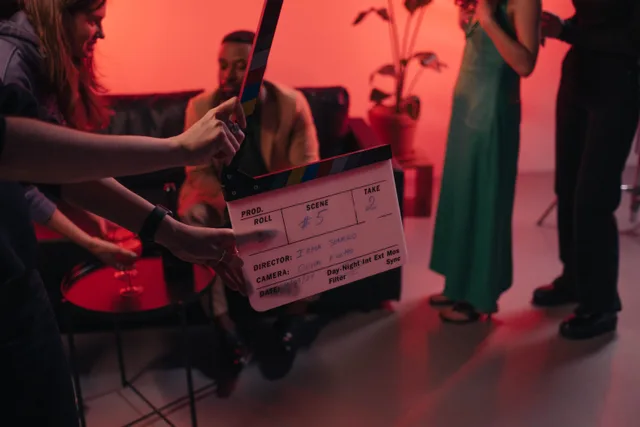
Then it is shot in fragments. The camera is placed to hide the distance between a fist and a face. The cut lands on the moment of contact so the impact is supplied by the edit and the sound design rather than by the blow.
Frame rate is changed to speed up or slow down a move. Wires are painted out afterwards, a process often called wire removal or rotoscoping. Shooting the same moment from several angles — coverage — is how a film performance is assembled; action is coverage taken to its limit, with the cut and sound design supplying the impact.
Who is in the frame
More people than the credits suggest.
Who does what in the frame
Performer
- Face and close shots
- Yes
- Risky or repeated parts
- Limited
- Skill the performer lacks
- No
- Safety authority
- No
- Start and end of move
- Yes
Stunt double
- Face and close shots
- No
- Risky or repeated parts
- Yes
- Skill the performer lacks
- Yes
- Safety authority
- No
- Start and end of move
- No
Coordinator
- Face and close shots
- Assigns
- Risky or repeated parts
- Assigns
- Skill the performer lacks
- Assigns
- Safety authority
- Final word
- Start and end of move
- Assigns
The end titles are where those roles surface: the stunt coordinator is credited, and the stunt department is normally listed with them. A second unit director, where a production uses one, gets a separate credit.
Doubles are not a comment on the performer. A lead who is injured in week two stops a production that employs hundreds of people, and the insurer prices that risk. The schedule, not the performer's courage, decides what they are allowed to do.
Reading the sequence as a viewer
Once you know it is an assembly, the seams become visible, and watching for them is a way of appreciating the craft rather than debunking it.
A camera behind a head during a punch hides the miss, and a wide shot with the face turned away is probably the double. A cut on every impact means post supplied it.
A body arcing through the air with a slightly wrong weight was on a wire. None of that is deception; the medium does what it does.
It also shows why the "own stunts" question misleads. It collapses a team into one person, and it treats a decision made by a coordinator and an insurer as a measure of character. The honest answer for almost every performer in almost every sequence is "some of it", and which parts is not visible from the screen.
In series television, where a sequence is shot in a fraction of the time a film would give it, the share done by doubles is usually higher still. The page on the pace of television production explains why time is the thing television never has.
Where the authority sits
Before a stunt is shot there is a safety meeting, and the coordinator runs it. Everyone in the sequence hears what will happen, what the abort word is, and where the medic is. The coordinator's call on safety outranks the director's preference, and an experienced director does not argue with it.
Two things follow that a performer should know before the day. Anyone can stop a take by saying so, and no one is penalized for it. And rehearsals are usually recorded, so that the version everyone agreed to is on file if the shot drifts from it.
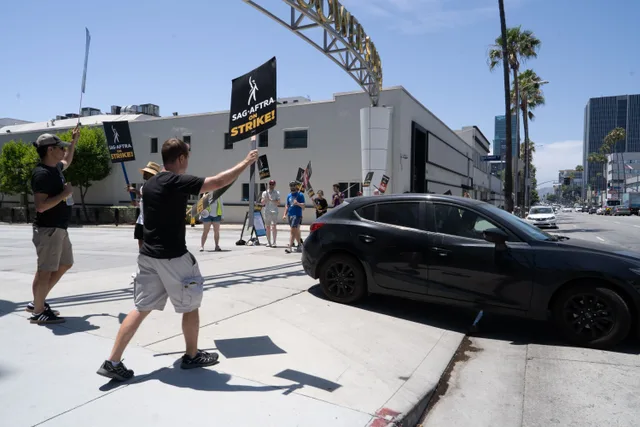
In the United States, SAG-AFTRA publishes Safety Bulletins and contract provisions for stunt work on signatory productions, and performers' unions in other countries do the same. Use them to learn standard practice. This page states none of it as a rule.
For the occupation's wider shape — where this work is done and how people enter it — the U.S. Bureau of Labor Statistics' Occupational Outlook Handbook is a useful reference.
Training for it, honestly
Physical preparation is a job requirement, and so is being honest with the coordinator about what you can and cannot do. Overstating a skill in a fight rehearsal endangers the other person in it. Formal programs such as the International Stunt School exist, but the working route is still through coordinators who have seen you train.
Injury is an occupational risk of this work, covered by the production's insurance and reported through the production. A production that asks you to sign away that cover, or keep an injury off the record, has told you what it is.
Stage combat works on the same principle in a different medium. On the page about rehearsal and the run, the fight captain keeps a choreographed sequence safe for months.
Common questions
Did they do their own stunts?
Some of them, as decided by the coordinator and the insurer, and you cannot tell which from the screen. The better question is who designed the sequence.
Why is the camera so close during fights?
To hide the gap between the strike and the target, and to let the cut supply the impact.
Is action work dangerous?
It is managed risk, with a professional whose whole job is managing it. The danger rises when a production skips the meeting, rushes the rehearsal or overrules the coordinator.
How do I get into stunt work?
Through stunt training and stunt coordinators, slowly, by being known to the people who assemble teams. Not through a registry that charges to list you. That holds in any market you are not already inside: coordinators hire people they have seen work.
In this guide
- Action actors list compared with what actually happensAction actors list: why the sequence is the only workable unit, what a list can record from credits, and the claim about who did which shot it must refuse.
- How to organize an action actors directoryAn action actors directory earns its keep by recording discipline, the role held on the day and the source of each credit, not the vague label 'action actor'.
- Action actors facts: how action work is organizedAction actors facts: how physical work is planned and rehearsed, who holds safety responsibility on a union set, and what a stunt credit cannot tell you.
- Action actors by country compared: where the records differAction actors by country compared: how credits, work rights and stunt records are kept differently in Canada, Korea, the UK and the United States.
- Action actors by year as practitioners see itA year-by-year list of action actors, with the shoot year, release year and stunt credits that place each performer on the industry timeline.
- Action actors in 2027: which credit counts hold up, and what a directory can publishWhy public credits rarely tie a named performer to a stunt beat, what common proxies such as screen time and film counts actually measure, where the Academy's new stunt design award fits, and the sortable fields a directory can publish instead of a ranking.
- Which action actors data sources hold up to checkingAction actors data lives in union rosters, studio payroll records and national film registries, and each source confirms a different field such as residuals.
- Action actors' credit records: how to maintain themAction actors' credit records need separate shoot and release dates, unit and source details, checked dates, and a traceable history for every correction.